Showing posts with label 2010. Show all posts

Friday, January 7, 2011

Hyundai i-flow Concept, 2010

Hyundai i-flow Concept, 2010


 Making its global debut at the 2010 Geneva Motor Show, the Hyundai i-flow Concept car carries forward the company's evocative new form language, 'fluidic sculpture'. The flowing, elegant lines not only create a bionic, futuristic shape, but also contribute to exceptional aerodynamics, helping to reduce the car's CO2 output to just 85g/km and fuel consumption to only 3l/100km.

Hyundai's first diesel hybrid powertrain is also a key factor in delivering such an environmentally-conscious return, as is the application of next-generation materials and technologies developed in cooperation with leading chemical company BASF.

Previewing a future D-segment contender
With an overall length of 4.780mm and a 2.800mm wheelbase, the Hyundai i-flow Concept brings new ideas and a pioneering form to the traditional European D-segment. The dramatically-sculpted forms of the interior and exterior make for a striking sports sedan, and its width and height (1.850mm and 1.420mm respectively) give it an athletic stance.

The name i-flow reflects the exceptionally aerodynamic shape and the flowing lines of the concept car's eye-catching styling, and retains the 'i' prefix of Hyundai's established alphanumeric nomenclature for Europe. In 2011 Hyundai will bring into production a new challenger in the segment, drawing on the Hyundai i-flow Concept's sleek styling and innovative technology.

Inside: minimum weight, maximum space and a bionic feel
The interior of Hyundai i-flow Concept redefines the perception of space in a sedan bodystyle. Fundamental elements, such as the seats and center console, were crafted for minimal weight and volume using cutting-edge materials from BASF - one of the world's leading automotive suppliers.

The seats, for example, were developed in conjunction with BASF using advanced stress analysis, which highlighted the unnecessary mass areas and pointed towards an optimized lightweight seat structure. 'Steron', a BASF material, gives the seats a highly-resilient quality, excellent breathability and a high-tech touch.

The upper dashboard, meanwhile, is treated with Elastoskin, a sprayed skin from BASF for a sophisticated, shimmering finish.
This technical, meticulous approach combines with an abundance of natural materials to engender a bionic feel in the cabin, further symbolized by the green color tones and the leaf-like shadows projected from the roof's semi-transparent dye-sensitized solar cells.

The cockpit's main interface centers around an expansive, contoured screen, which recognizes not only touch but also gestural inputs along its fascia-wide display. The fluidic forms of the exterior are echoed in the Hyundai i-flow Concept's cabin, where continuous lines sweep from the dashboard, through the doors to the open storage area at the rear.

Energy Conservation
BASF and Hyundai R&D engineers have developed thermal engine encapsulation, which ensures that the engine reaches optimum operating temperature more quickly, by retaining heat when the car is at idle. Where a non-insulated engine would take three hours to drop to 40°C, the Hyundai i-flow Concept will stay above that temperature for 14 hours. This translates into fuel savings and emissions cuts of 5 per cent during summer and up to 9 per cent during winter.

Energy Harvesting
Another pioneering technique introduced in collaboration with BASF is thermo-electric waste heat recovery. This process equates to further reductions in fuel consumption, 5% at highest driving. In fact, up to half of the electrical energy consumed by Hyundai i-flow Concept at 80kph - 250 watts - can be recovered through the work of a thermo-electric generator. Harvested energy from hot exhaust gases is recaptured by this generator which is fitted into the exhaust manifold. The thermal electric generator then converts the wasted heat into useful electrical energy to help power auxiliary systems.

Liquid Metal, a coating with the appearance of a glossy skin made of liquid metal, has been developed by BASF Coatings. Special effect pigments in this eco-friendly waterborne coating system let the surface appear as polished metal with targeted mirror like reflections - this gives a liquid skin appearance to the car's exterior and increases the tension of the surface in the same time. The high color saturation on the Hyundai i-flow Concept adds an energizing charisma to the Hyundai concept car. The typical high contrast between highlight and flop underlines the sculptural impact of the Hyundai i-flow Concept.

Thursday, January 6, 2011

2010 Hyundai Genesis Sports Car Coupe with SHIFTRONIC to handle the additional torque

2010 Hyundai Genesis Sports Car Coupe with SHIFTRONIC to handle the additional torque

2010 Hyundai Genesis Sports Car Coupe

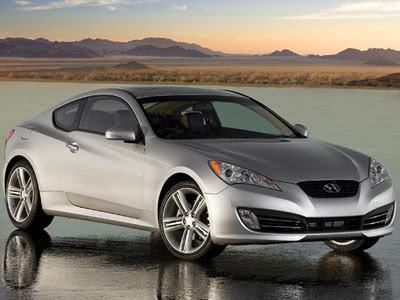
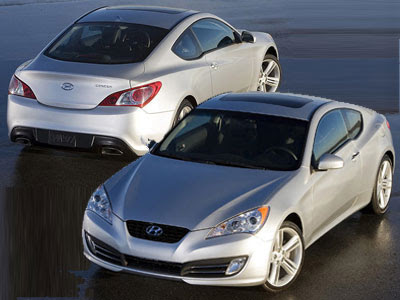
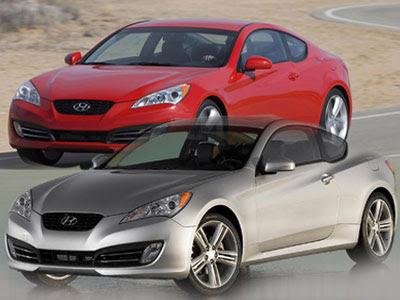
The people at South Korean automaker Hyundai are listening to their customers. The 2010 Hyundai Genesis Coupe, confirmed for production and a release early in 2009, follows the tradition of the 2009 Hyundai Genesis in offering a true high performance rear wheel drive, sporty architecture in an affordable package. The 2010 Genesis Coupe is a purpose-built rear-wheel drive sports coupe featuring two performance-focused engines - a212-horsepower 2.0-liter turbocharged four-cylinder engine and a range-topping all-aluminum 306-horsepower, DOHC 3.8-liter V6 engine.

2010 Hyundai Genesis Sports Car Coupe

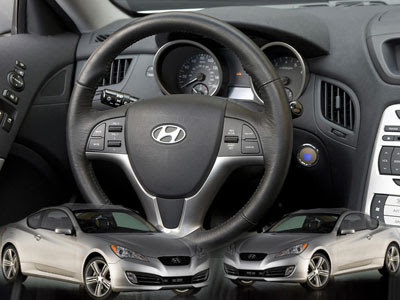
Genesis Coupe employs a MacPherson strut dual-link front suspension and a five-link rear suspension setup. Both engines are mated to a standard six-speed manual transmission. The Genesis Coupe 2.0t (2.0-liter 4-cylinder turbo) offers an optional five-speed automatic with SHIFTRONIC® while the 3.8-liter V6 offers a ZF six-speed automatic transmission with SHIFTRONIC to handle the additional torque.
The Genesis Coupe follows the styling tradition set forth by the Hyundai Tiburon, but outdoes that aging Hyundai compact sports car in every way. The Genesis Coupe comes with an available naturally aspirated V6, sure to be a motor to find its way into more of Hyundai's lineup. The high output engine offers 310 horses on premium fuel. Following the introduction earlier this year of the rear-wheel drive Genesis sport sedan, Hyundai Genesis Coupe is Hyundai's most dynamic performance car ever and the second consecutive all-new model introduction from Hyundai appealing directly to the car enthusiast.

2010 Hyundai Genesis Sports Car Coupe

Hyundai Genesis Coupe uses the same flexible rear-wheel drive architecture originally developed for the Genesis sport sedan.
The 2010 Hyundai Genesis Coupe offers Xenon high-intensity discharge (HID) headlights. The advantages of HID headlamps include greater lighting power, daylight-type lighting and reduced power consumption. In addition, the cut lines of the new HID headlights are extremely precise, providing maximum nighttime visibility without distracting other drivers.
All Hyundai Genesis Coupe models feature standard four-channel ABS with Electronic Brake-force Distribution (EBD) to optimize brake performance under various dynamic loading conditions. The system also includes Brake Assist, which provides maximum ABS-level braking force when a panic stop is detected.

2010 Hyundai Genesis Sports Car Coupe

It is nice to see that Hyundai, an automaker currently enjoying growth and a solid reputation for producing mainstream-market cars that last, is making steps toward the sports car market. The styling of the Genesis Coupe is hit or miss, some will love it and others will wonder what Hyundai was thinking. But, with the sports car pedigree to back it up, the Genesis Coupe should be another worldwide hit for Hyundai.

2010 Hyundai Genesis Sports Car Coupe

The Hyundai Genesis Coupe is offered in three trim levels: the stylish and affordable GS, the premium-sport GT featuring the 3.8-liter V6, and the high-performance SE, available with either the 2.0-liter turbocharged four-cylinder engine or the 3.8-liter V6 engine.

Sunday, December 26, 2010

Alfa Romeo 159 1750 TBi, 2010

Alfa Romeo 159 1750 TBi, 2010


The new 159 is designed to express a sporting yet seductive personality and boasts road holding and performance that set new standards for this class of car. Two new engines in particular (a 200 HP, 1750 cc turbocharged petrol engine and a 170 HP 2.0 JTDM diesel) place the Alfa Romeo 159, in the power range that accounts for over half of Alfa Romeo sales.

Under their fascinating and highly personal exterior, all Alfa Romeos a choice of superb engines, all packed with the latest technology and bursting with performance. Alfa Romeo engines are the perfect embodiment of the sporting soul that has always set the marque apart from the competition. The Alfa Romeo 159 is certainly no exception.

The new 1750 cc turbo petrol engine (manufactured by FPT - Fiat Powertrain Technologies) comes combined with a six speed manual gearbox and boasts advanced ignition control solutions including direct fuel injection, two continuously variable valve timing units, a turbocharger and a revolutionary scavenging control system. The resulting performance is comparable to - or better than - that of many 3 litre engines while still delivering fuel consumption typical of a compact four cylinder unit.

The force behind the development of any Alfa Romeo engine is the company's determination to use technology to enhance driving pleasure. This certainly applies to the development of the new, Euro 5, "1750 Turbo Benzina 200 CV" unit destined immediately for the Alfa Romeo 159 and later on for the Alfa Romeo Brera, Spider and 159 Sportwagon.

The engine takes the Alfa Romeo 159, with its refined Italian styling and typical sporting elegance to an impressive top speed of 235 kph and accelerates it from 0 to 100 kph in just 7.7 seconds. The 200 HP Alfa Romeo 159 1750 TBi is therefore a true representative of Alfa's exclusive motoring lifestyle. Far from being a mere 'means of transport', the new 159 is a real driver's car. It delivers genuine sports performance and muscular acceleration thanks to generous torque and smooth response even at low revs and the extended power band of a modern, advanced petrol engine that minimises the need for you to 'work' the gearbox. The engine sound too is inspiring without ever becoming tiresome.

Alfa Romeo 2uettottanta Concept, 2010

Alfa Romeo 2uettottanta Concept, 2010


To mark its 80th anniversary, Pininfarina proposes an "open" Alfa Romeo 2uettottanta Concept that is exciting and a delight to drive. For those who still like to dream in a car. For those looking for a mixture of vanity, entertainment, and the pleasure of life in the open air. For those who love icons as the greatest expression of the age we live in. For those who want their cars to be an uncommon sensory experience in terms of both style and driving, without being obsessed by performance. For those who want to be excited by a dynamic, sporty car that transmits the exclusiveness and refinement typical of an Alfa Romeo spider designed by Pininfarina.

2uettottanta: a name that evokes the legendary Duetto, but also the years of activity at Pininfarina, which launches the celebrations for its 80th anniversary with this concept car. And it has decided to do so with a type of car that is by definition, the work of Pininfarina: an Alfa Romeo spider. A very Italian product, which has become an export brand, representing the inexhaustible talent that the whole world associates with Italy.

The Alfa Romeo 2uettottanta Concept reflects Pininfarina's determination to look to the future with optimism following tradition, restating its excellence in design and its acknowledged capacity for aesthetic and technological innovation. It is a concept that represents an innovative approach, projected into the third millennium, to a topic that is firmly rooted in Pininfarina history, the 2-seater spider. And like the best Alfa Romeo sports cars to come from Pininfarina's pencil, the Alfa Romeo 2uettottanta Concept exalts the driving experience and concentrates on the excitement of being at the wheel of an open car with a great aesthetic personality. It is a car that can make people dream and excites even after many years. The icon of a lifestyle that harks back to a lively, tumultuous period. Like the Duetto of the Sixties, which helped to establish a trend based on the themes of rebellion and escape, thanks to the film "The Graduate".
Alfa Romeo 2uettottanta Concept

The Alfa Romeo 2uettottanta Concept is also a tribute to Alfa Romeo, which celebrates its centenary in 2010: the alliance between Alfa Romeo and Pininfarina is one of the most significant and durable in the history of the car, one of men and of passion, of design and cutting-edge technical solutions, which has generated an inestimable number of good-looking, innovative cars with plenty of temperament. With a predilection for sports cars and convertibles. The aim is to replicate all this with the Alfa Romeo 2uettottanta Concept. So a clean, elegant line was chosen for this "simple 2-seater", which is proposed with a 1750 cc turbo engine positioned longitudinally, an obvious reference to the "1750 Veloce" of 1968, one of the many versions derived from the famous "Osso di Seppia" (Cuttlefish). With its red bodywork, inspired by the typical Alfa Romeo paintwork, the 2uettottanta is 1797 mm wide, 4212.6 mm long, 1280 mm high and has a wheelbase of 2500 mm.

The pleasure of driving and feeling in harmony with nature is transformed into light, sleek, refined volumes, and shapes that seem to slip through the air easily. This generates the theme of this concept: the expression of a single volume, which is some way from the ground and suspended. The Alfa Romeo 2uettottanta Concept almost seems to lift up from the ground "going further". It is an optical effect achieved thanks to a line that crosses the whole car horizontally. An uninterrupted sign applied to dynamic, sporty proportions - typical of Alfa Romeo spiders - accentuated by the configuration of the passenger compartment, which is shifted significantly to the rear. The force of the design lies in its exaltation of simplicity, which does not need to show its muscles but concentrates purely on agility and harmony.

The front end of the Alfa Romeo 2uettottanta Concept underlines its true Alfa Romeo character. The design is simple, with a central line that runs smoothly along the nose of the car, while the execution of the surfaces is more sophisticated. At the centre, in full view, and anything but a purely decorative element, is the Alfa Romeo shield, which seems to emerge from the heart of the car and to stretch outwards, in Pininfarina's futuristic, three-dimensional approach. The shield is made of aluminium and incorporates floating horizontal flaps. On either side are the two triangular lateral air intakes. The two elements impressed on the imposing bonnet create a natural link between the logo and the large windscreen, which has been designed as a ring in hand-beaten aluminium that emerges from the body of the car without interrupting its flow. The front headlights, which adopt the latest LED technologies, are embedded under the line that gives the whole car its character. A strip of carbon in the lower part of the front acts as an air splitter, channelling the air to the rear end of the car.

The side view of the car, where the theme of the single volume is repeated, highlights the flowing line of the whole, with the shapes merging naturally. The horizontal line "cut" into the sides gives a sense of great dynamism; it starts from the front wheelarch and extends back to the rear wheel. Like an athlete, for a car, being slim also means achieving aerodynamic efficiency. Pininfarina has always strived for natural shapes that can convey efficiency and respect of the environment, an approach confirmed by its great commitment to the theme of eco-sustainable mobility. The Alfa Romeo 2uettottanta Concept is in perfect harmony with nature, becoming the formal expression of a response to the needs of our day: it is an arrow that flies through the wind almost without encountering resistance.

Smooth, essential, soft surfaces even at the rear, which echoes the front, albeit with slightly more emphasis on the muscles. The design combines stylistic simplicity with a strong character in the volumes and proportions, with details designed to underline the car's dynamic, light personality. The two bumps seem to emerge from the volume, becoming floating wings that create the roll-over bars behind the seats. At either end, these bars generate an appendix designed to hold the seat belts. Even at the rear the light clusters are slender and embedded under the line that defines the whole section.

Great attention went into the design of the interior. The result is a spacious, comfortable passenger compartment, conceived with light, dynamic volumes, which envelop the occupants in a strong, reassuring embrace. The shapes are sewn into the leather, incorporating the touch controls: in its functions, the Alfa Romeo 2uettottanta Concept is faithful to its vocation as a car designed to be a delight to drive. The facia extends fluidly to the sides merging into the doorway as the natural continuation of the volume of the car, thus creating a perfect symbiosis between exterior and interior. The dashboard has a driver-oriented configuration with an innovative approach to the classical circular Alfa Romeo "tubes" that contain the instruments. The tunnel contains the Alfa DNA gear selector in an ergonomic position; this varies the set-up of the car in three modes, Dynamic, Normal and All Weather, adapting the behaviour of the various systems on the vehicle (engine, transmission, suspension, steering, brakes, etc.) to the demands of the driver and the different driving conditions. The tunnel runs through the passenger compartment and it gives structure to the chassis, revealing the carbon elements: the choice of this material reflects Pininfarina's constant research into alternative materials that can make vehicles lighter, reducing consumption and emissions. Another strong element of the interior is the steering wheel, which is a modern interpretation of the Duetto's perforated three-spoke wheel, with the addition of a shift paddle for sequential control of the dual-clutch gearbox. An enjoyable drive and comfort are also guaranteed by the anatomical sporty seats. All the interior of the car "floats": the ventilation ducts are positioned between the passenger compartment and the hull.

The size and design of the tyres, which were created specifically for the Alfa Romeo 2uettottanta Concept in collaboration with Dunlop, accentuate the impression of strong character and force given by the car. The tyres are of the low profile type, right on the extreme edges of the plane view: designed by Pininfarina to incorporate the innovative technologies developed by Dunlop, their graphics reflect those of the car. Their aerodynamic shape and very smooth lateral profile, guarantee better roadholding and less resistance to air, thus reducing consumption. The rims are treated in aluminium in harmony with the rest of the car, and are a free interpretation of the classic five-circle Alfa Romeo pattern, revealing the high performance carbo-ceramic Alfa Romeo brakes by Brembo.

The Alfa Romeo 2uettottanta Concept is not a pure styling exercise, but also a project and research: the goal is to grasp the spirit of the spider in the configuration, the proportions and the conception of the car as well as in its stylistic imprint. This working method is part of Pininfarina's genes. For this project, the Pininfarina creative team were given carte blanche to express the values inherent in the Alfa spider "by Pininfarina", the values that are deemed to have made the Giulietta Spider or the Duetto all-time classics. To achieve this result, the car was given a particular set-up, with a low centre of gravity and a passenger compartment that is very exposed so as not to isolate the occupants from the surrounding environment. The result is to bring the road "nearer" to the eyes of the driver and to increase the sense of dynamism even at low speed.

What is the 2uettottanta effect? Desire. Whoever sees it "must" possess it, drive it, enjoy it. Because the 2uettottanta is not an unattainable dream. Nor does the 2uettottanta only want to impress at first glance, but to achieve a beauty that does not strive solely for immediate confirmation, but gradually reveals all its values and transfers them to the future, making the style eternal. As it did in the case of the Duetto, which continues to be celebrated as an icon of design after more than 40 years.

Sunday, December 19, 2010

2010 Lotus Sport Cars T127 Formula One

2010 Lotus Sport Cars T127 Formula One
Lotus has just unveiled its 2010 Formula 1 car, after 15 years one of the most successful names in Formula One returns to the grid with the launch of the Lotus T127. Backed by the Malaysian government, the new Lotus team will field two cars, driven by Jarno Trulli and Heikki Kovalainen. Lotus the T127 will be one of several cars using the latest Cosworth V8 this year.
2010 Lotus Sport Cars T127 Formula One
2010 Lotus Sport Cars T127 Formula One Racing is backed by the Malaysian Government - where Lotus owner Proton is based - securing the rights last year to the team's name and legendary green and yellow colours. Mike Gascoyne, technical chief for the T127, admitted the car was designed very quickly, the team revealing its car mere weeks ahead of the 2010 Bahrain F1 Grand Prix.
The Lotus T127 is powered by a Cosworth engine - another name returning to the sport cars after an extended absence - and will use an Xtrac transmission, in line with all 2010 teams, will be running on Bridgestone tyres.
2010 Lotus Sport Cars T127 Formula One

Monday, December 13, 2010

2010 Nissan Sports Cars iv Concept

2010 Nissan Sports Cars iv Concept
At the 2010 Los Angeles Auto Show also includes the LA Design Challenge, a competition that has asked automotive producers from around the world to create eco-conscious vehicles with a top design that weigh less than 1,000 pounds (454 kg).
In 2010, Nissan launched an innovative LEAF as the first mass production electric vehicle in the world, as well as a beginning for the future vision of zero emissions Nissan. Forward to 2035: electric vehicles and green technology infrastructure which matured into a fully sustainable dream, that brings to life.
2010 Nissan Sports Cars iv Concept
Using industry-leading technology, Nissan iV maximize the driving experience by eliminating excess. Nissan makes deep longing and joy of driving with EV that can offer exciting and strikingly beautiful, fast performance with zero fault.
2010 Nissan Sports Cars iv Concept
Infused with Nissan’s heritage of sports cars and performance, 2010 Nissan Sports Cars iv Concept is a high-performance EV inspired by nature’s intelligent beauty and crafted by human ingenuity. The iV is a super-lightweight sports cars tourer that showcases “organic synthetics,” a revolutionary manufacturing technique in which automotive parts are cultivated like agriculture in a 100% sustainable, carbon-neutral process.
2010 Nissan Sports Cars iv Concept
Every detail is the vehicle uses an interwoven organic frame, that is built from a biopolymer frame which mixes fast-growing ivy and re-enforced with spider silk composite. This allows the frame to be flexible and light, yet ultra-strong.
The 2010 Nissan Sports Cars iv Concept seats four  and features a photo-voltaic rooftop, a slim bio-battery provides stability and regenerative capacitor technology that recoups 60% of kinetic energy spent.
The vehicle is powered by concentric hub-less in-wheel electric motors, which also acts as a suspension and steering, using magnetic levitation and propulsion. Concentric magnetic rings amplify rotation with each outer ring to boost high-speed performance and provide independent wheel control for ultimate handling and maneuverability.
2010 Nissan Sports Cars iv Concept
Nissan’s president Carlos Ghosn has publicly said that the company’s success depends on its ability to develop and deploy electric vehicles that excite the masses. The 2010 Nissan Sports Cars iv Concept is  part of Nissan’s zero emissions future. The Renault/Nissan partnership with Better Place will result in more than 100,000 battery-swap enabled sedans on the road in Israel and Denmark, with cars and charging infrastructure slated for Toronto, Hawaii and the San Francisco Bay Area.
Through superior technology, 2010 Nissan Sports Cars iv Concept maximize the driving experience by eliminating the excess burden. Nissan will meet a deep longing for pleasure driving with beautiful electric car capable of providing satisfactory performance without the need to feel guilty.
2010 Nissan Sports Cars iv Concept

2010 Nissan Sports Cars iv Concept

2010 Nissan Sports Cars iv Concept
At the 2010 Los Angeles Auto Show also includes the LA Design Challenge, a competition that has asked automotive producers from around the world to create eco-conscious vehicles with a top design that weigh less than 1,000 pounds (454 kg).
In 2010, Nissan launched an innovative LEAF as the first mass production electric vehicle in the world, as well as a beginning for the future vision of zero emissions Nissan. Forward to 2035: electric vehicles and green technology infrastructure which matured into a fully sustainable dream, that brings to life.
2010 Nissan Sports Cars iv Concept
Using industry-leading technology, Nissan iV maximize the driving experience by eliminating excess. Nissan makes deep longing and joy of driving with EV that can offer exciting and strikingly beautiful, fast performance with zero fault.
2010 Nissan Sports Cars iv Concept
Infused with Nissan’s heritage of sports cars and performance, 2010 Nissan Sports Cars iv Concept is a high-performance EV inspired by nature’s intelligent beauty and crafted by human ingenuity. The iV is a super-lightweight sports cars tourer that showcases “organic synthetics,” a revolutionary manufacturing technique in which automotive parts are cultivated like agriculture in a 100% sustainable, carbon-neutral process.
2010 Nissan Sports Cars iv Concept
Every detail is the vehicle uses an interwoven organic frame, that is built from a biopolymer frame which mixes fast-growing ivy and re-enforced with spider silk composite. This allows the frame to be flexible and light, yet ultra-strong.
The 2010 Nissan Sports Cars iv Concept seats four  and features a photo-voltaic rooftop, a slim bio-battery provides stability and regenerative capacitor technology that recoups 60% of kinetic energy spent.
The vehicle is powered by concentric hub-less in-wheel electric motors, which also acts as a suspension and steering, using magnetic levitation and propulsion. Concentric magnetic rings amplify rotation with each outer ring to boost high-speed performance and provide independent wheel control for ultimate handling and maneuverability.
2010 Nissan Sports Cars iv Concept
Nissan’s president Carlos Ghosn has publicly said that the company’s success depends on its ability to develop and deploy electric vehicles that excite the masses. The 2010 Nissan Sports Cars iv Concept is  part of Nissan’s zero emissions future. The Renault/Nissan partnership with Better Place will result in more than 100,000 battery-swap enabled sedans on the road in Israel and Denmark, with cars and charging infrastructure slated for Toronto, Hawaii and the San Francisco Bay Area.
Through superior technology, 2010 Nissan Sports Cars iv Concept maximize the driving experience by eliminating the excess burden. Nissan will meet a deep longing for pleasure driving with beautiful electric car capable of providing satisfactory performance without the need to feel guilty.
2010 Nissan Sports Cars iv Concept